
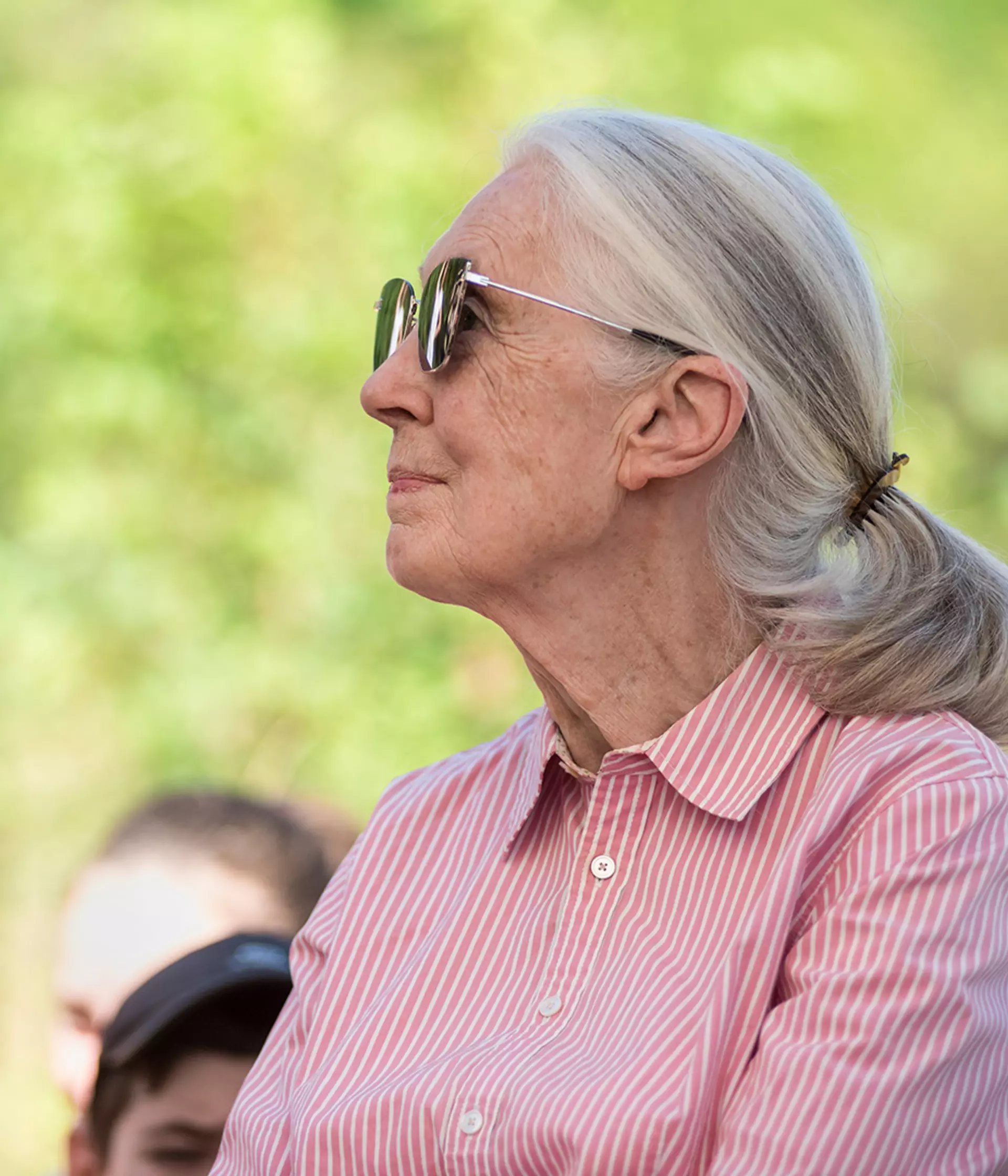
Dame Jane Goodall, the world-renowned primatologist and conservationist who transformed our understanding of chimpanzees and inspired millions to protect the natural world, has died aged 91.
She was considered by many to be the world's foremost expert on chimpanzees, but her impact reached far beyond the scientific community. With her warm demeanour and patient, compassionate approach to observing animals, Goodall became a beloved global icon – someone who showed that you didn't need to be a traditional scientist to make revolutionary discoveries. Her ability to communicate the emotional lives of chimpanzees made complex science accessible to everyone, and her message that every individual can make a difference inspired generations to care about conservation.
A revolutionary approach
Jane Goodall revolutionised the study of animal behaviour through her groundbreaking research with chimpanzees in Gombe Stream National Park, Tanzania. Her pioneering methods – observing animals in their natural habitat, naming rather than numbering her subjects, and recognising individual personalities – challenged the scientific orthodoxy of her time and fundamentally changed how we understand our closest living relatives.
"Jane Goodall's death marks the passing of one of the great figures from conservation," said ZSL Chief Executive Matthew Gould. "Her career is intertwined with ZSL, and we are proud of our connection with her."
A complex history with ZSL
Our relationship with Dr Goodall began in 1958 when she worked in Granada Television’s film library - housed inside London Zoo - where she spent her spare time studying the behaviour of primates while waiting for expedition funding to come through.
Four years later in April 1962, after an expedition to Gombe National Park, Tanzania, where she made observations that challenged conventional science – including that chimps make and use tools – she presented her early field observations to ZSL at a symposium on primates.
Her unconventional approach initially met with scepticism from parts of the scientific establishment.
Matthew Gould reflects: "Some members of the scientific community, including – I am ashamed to say – a scientist from ZSL, were critical, dismissing her work as 'anecdote and... speculation' based on ‘contradictory and isolated observations’ that contributed little to science."
Recognition and reconciliation
History, of course, proved the critics wrong. Dr Goodall's methods became the foundation of modern primatology and ethology, demonstrating that scientific rigour and empathetic observation are not only compatible but essential to understanding animal behaviour.
We later honoured Dr Goodall's extraordinary contributions to science. In 1996, she received the ZSL Silver Medal, our highest scientific honour, awarded to those who have made exceptional contributions to the understanding and appreciation of zoology.
She returned to our zoos over the years, giving talks and meeting with staff and ZSL members – and of course visiting our chimps at Whipsnade.
An enduring legacy
Dr Goodall's influence extended far beyond academia. Through the Jane Goodall Institute and her Roots & Shoots programme, she inspired millions of young people worldwide to become advocates for wildlife and environmental conservation. Her message of hope, combined with her tireless activism well into her later years, created a global movement for positive change.
Her discoveries reshaped our understanding of what it means to be human – revealing that tool use, complex emotions, and sophisticated social structures are not uniquely human traits. In doing so, she helped forge a deeper connection between humanity and the natural world.
"Today, we remember one of the great figures of conservation, who transformed our understanding of primates, and inspired millions with her work, and give thanks for her remarkable life," said Matthew Gould.
Dame Jane Goodall's legacy lives on in every researcher who approaches their work with both rigour and compassion, in every conservationist fighting to protect endangered species, and in every young person who believes they can make a difference for our planet.
________________________________________
Dr Jane Goodall DBE 1934 - 2025
Our tributes
"I’m very sad to hear of the loss of Dr. Jane Goodall; she was an inspirational scientist whose groundbreaking research and lifelong commitment to animal welfare and wildlife conservation changed the world. As one of the first women in her field, Jane opened doors for generations of women in science and inspired us all to make the world a better place for animals and people.
"I have personally been inspired by Jane as she has shown me that women can be impactful leaders in traditionally male dominated fields like wildlife conservation. ZSL will carry on her legacy by continuing to promote wildlife conservation through science and advocating for a world where wildlife thrives."
Amanda Guthrie
Head of Wildlife Health Services at London Zoo
"I have very fond memories of meeting Dr Jane Goodall at London Zoo. We shared a passion for Great apes and conservation and I will always remember Jane’s signature chimpanzee greeting that she began her talks with. It’s a privilege for me to work for ZSL and help inspire future conservationists, including my own young daughters, in the same way Jane did."
Dan Simmonds
Zoological Operations Manager/ London Zoo Head Keeper
"I was very sad to hear the passing of Jane Goodall, only yesterday evening. She was a great humanitarian, who has helped so many understand there is a lot more to animals than meets the eye. Her research with chimpanzees - which focused on promoting better care and understanding of habitats and nature, particularly with youth communities - is a legacy of its own, that she has left with us. Today I want to celebrate her as an incredible ambassador teaching is all, how truly amazing the natural world is!"
Glynn Hennessy
Lead Keeper at London Zoo, Primates