
There’s never a dull moment at London Zoo. From beautiful birds to radiant reptiles, there's a kaleidoscope of colour waiting to be discovered this May half term.
From 23 - 31 May, we're exploring the wonder of colour and pattern in the natural world, with a giant paint-by-numbers GUINNESS WORLD RECORDS® attempt!
London Zoo will transform into a vibrant creative hub with fun for the whole family. As we get ready for the flamboyant feat, discover the role of colour for some of your favourite Zoo animals...




Turquoise dwarf geckos can actually be olive-green
As their name suggests, these reptiles are a striking colour. But it's actually only the males that are electric blue, while the females are a more subtle olive-green. This difference between the two is called sexual dichromatism, and it's quite common in the animal kingdom, often to attract a mate (bright colours can signal good health and genetics), or for camouflage (females may need to stay hidden while nesting or caring for young).
Sadly, perhaps heightened by their vibrancy, turquoise dwarf geckos are under threat from the international pet trade and they are Critically Endangered on the IUCN Red List. Alarmingly, at least 15% of their global population was collected for the pet trade between 2005 and 2009.
The parents of the geckos that you can see in our Secret Life of Reptiles and Amphibians habitat were seized from the illegal wildlife trade, and they are part of an EAZA breeding programme to safeguard the future of the species.

Zebras - white with black stripes, or black with white stripes?
Actually, zebras aren't born black and white; foals have brown and white stripes, which get darker as they grow. And some zebras even have spots as well as stripes.
A group of zebras is called a dazzle - and the stripes definitely help to provide a dazzling form of camouflage. When zebras are moving in a herd, their stripe patterns can make it hard for predators, like lions, to pick out individual animals.
There are also many other theories around why a zebra has stripes. Every one has a unique stripe pattern and their distinctive coats may help them to recognise each other. Another thought is that their markings prevent attacks from disease-carrying horseflies, which avoid striped surfaces. Scientists have also suggested that their stripes help to regulate their body temperature, and could even act as a natural sunscreen.

Don't miss our GUINNESS WORLD RECORDS® title attempt, plus get hands-on with a whole host of creative activities including our Guess Zoo? game, camouflage quiz, wild costume challenge, and animal drawing classes. Don't miss out, book Zoo tickets today.


Emerald tree boas aren't born green
These snakes can be tricky to spot against their leafy habitat here at the Zoo. And this form of camouflage comes in handy to avoid predators in the wild, like large birds of prey, in the tropical rainforests in South America.
But they aren't green when they're young. Emerald tree boas begin life as a brick red colour, providing camouflage within leaf litter, and become a beautiful green colour as they grow up allowing them to blend in with the canopy.
This colour transition, when a species' colour changes as it develops, is known as an ontogenetic colour change.
Fun fact: These snakes have heat sensitive 'pits' on their heads which help them find their prey using infrared radiation.

Why do penguins wear tuxedos?
Penguins aren't black and white by accident, their colour pattern is a really effective survival adaption called countershading. When they're swimming in the ocean, their black backs blend into the dark ocean depths when viewed from above, while their white bellies blend into the bright surface when viewed from below. This makes them more difficult for predators to spot and gives them an advantage when sneaking up on prey.
Our Humboldt penguins on Penguin Beach may all look like they’re wearing the same tuxedo, but if you look closely, you'll notice that they all have different spots on their fronts which are unique to each one, just like a human fingerprint.


Dart frog danger
These tiny little amphibians don't look like they could do any harm. But they're actually highly toxic and their bright blue colouring acts as a warning, a defence mechanism called aposematism.
Instead of blending into their surroundings and hiding away from predators, poison dart frogs are brightly coloured to advertise to any predator that they are poisonous and warn them to stay away. They get their toxicity from eating insects in their tropical rainforest home.

Scarlet ibis - you are what you eat
Scarlet ibis chicks actually have a black plumage when they first hatch, which provides better camouflage while they are young and vulnerable. Their feathers eventually turn grey, then brown, and after around two years, they'll be covered in their vibrant scarlet feathers.
Their colouring comes from eating a carotenoid‑rich diet, just like a flamingo is pink because of the pigments in the crustaceans and algae they consume.

A streak of tigers
A tiger's stripes break up their body outline making them hard for prey to spot in amongst long grass.
At London Zoo, we're home to Sumatran tigers, and they have the narrowest black stripes of any tiger subspecies and they're also the darkest in orange. This is because they are ambush predators in the Indonesian jungle and it helps them to blend in amongst the thick vegetation.
No two tigers are the same, as each has its own unique stripe pattern, just like with zebras. This makes tigers identifiable to each other, and also to conservationists in the wild who are working to protect these critically endangered big cats.
Although mostly solitary, the collective noun for tigers is a streak, which often refers to a mother and her cubs.

Colour-changing chameleons
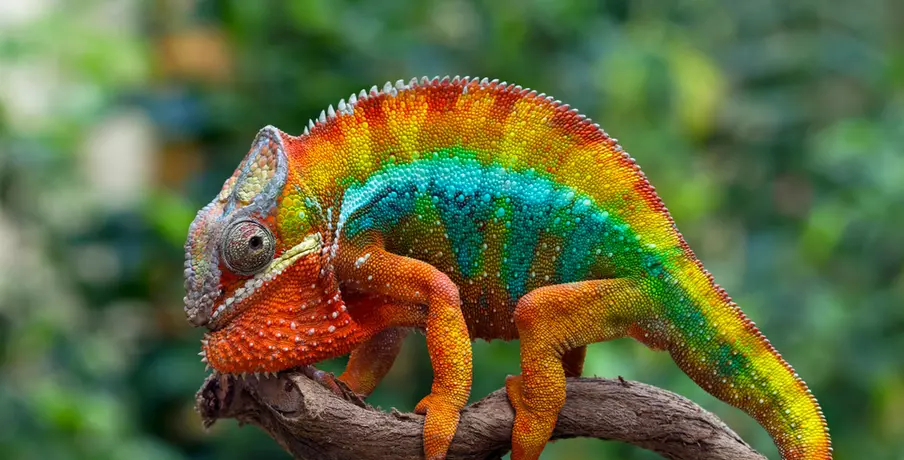
At London Zoo, you'll find panther chameleons, which are famous for their rapid colour changes. But did you know that the primary role of this incredible ability is to communicate their mood and regulate their body temperature, rather than for blending into their environment?
When trying to attract a mate or to show aggression, for example, chameleons can be more intensified shades of red, yellow and orange. But when they're resting they can be seen in calmer green and blue shades.
So how do chameleons change colour? Put simply, they adjust a layer of particles called nanocrystals in their skin. These nanocrystals are a variety of sizes, shapes and arrangements, which a chameleon can alter by moving closer together or further apart to reflect light in different ways, enabling them to change colour. Clever stuff!