

3 March 2026
When did the first penguin arrive at London Zoo? What different species have called the Zoo home? Learn all about the penguins throughout our history, and how our understanding of animal care has developed over the past 200 years.
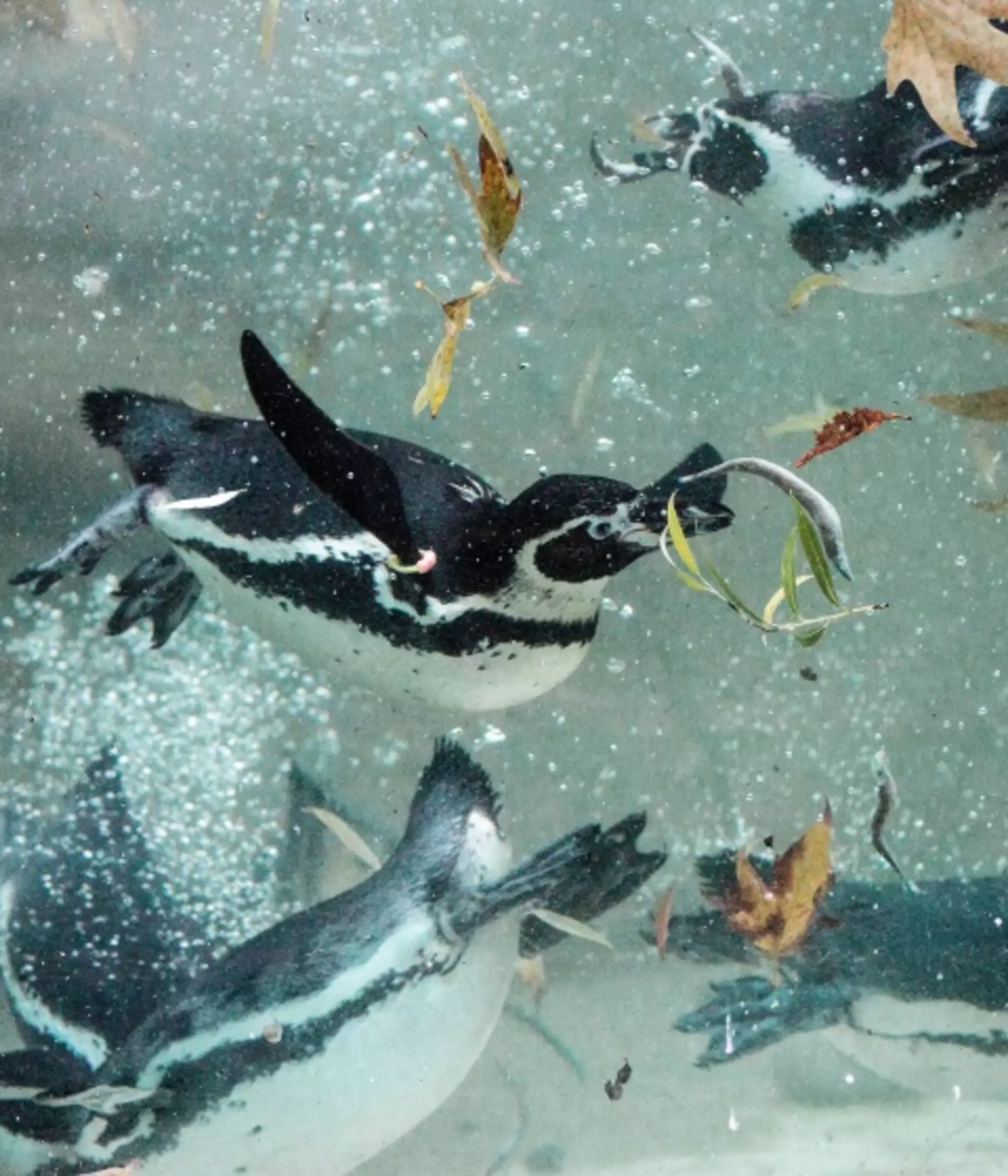
Penguins are among the most popular animals at both London and Whipsnade Zoos. With so much charisma, these animals are fascinating to watch, particularly when they can be found ‘porpoising’ at London Zoo’s Penguin Beach – they leap out the water to breathe while swimming, in a similar way to porpoises and dolphins.
Needless to say, the ZSL Library and Archives team regularly receive questions about penguins previously housed at our Zoos, often centred around the ‘big firsts’. As ZSL celebrates 200 years of wildlife, take a dive into this blog written by ZSL's former Librarian, Ann Sylph, to find out more.
The first penguin to visit London Zoo
The first live penguin at London Zoo, and the first at any zoo in the UK, was a king penguin arriving from the Falkland Islands in 1865. According to the Annual Report for that year, the animal was "skilfully conveyed to this country by Commander Fenwick, of HMS Harrier...this strange looking bird attracted universal attention".
In the V&A's collections there is a wonderful cartoon by Ernest Griset of this very penguin surrounded by many artists trying to depict this most unusual creature. The cartoon is reproduced in Lionel Lambourne's book Ernest Griset: fantasies of a Victorian illustrator, a copy of which can be found in the ZSL Library and can be viewed when you visit the Library and Archives1.
The 1865 Daily Occurrences in the ZSL Archives, and the Proceedings of the Zoological Society states that this first king penguin arrived on 27 March 18652&3 generating lots of interest. Unfortunately, the excitement was short-lived, as records show the individual sadly died less than two months later on 19 May 18654.
More king penguins and breeding success
The next king penguin was presented to London Zoo by Mr F.P. Cobb, Manager of the Falkland Islands Company, Port Stanley. It was brought to London by Mr W.H. Hyde of the Royal Navy on HMS Reindeer, arriving on 8 January 18725. The individual was a young penguin, said to have immature brown plumage, and once again sadly died just a few weeks after its arrival.
It was several decades before we had any success with breeding king penguins at London Zoo, with the first three chicks hatching in August 19526.
The following year, ZSL's Bronze Medal was awarded to Head Keeper H. Jones for the first successful rearing of king penguins in England.


200th Anniversary Tours
Learn more about 200 years of history at ZSL with an anniversary tour at London Zoo.

Penguins through the 19th century
Other species of penguin arriving at London Zoo in the 19th century included a rockhopper in 1873, closely followed by a gentoo penguin in 1874. Subsequent penguins included two individuals, one Humboldt and one African (otherwise known as black-footed or Jackass penguin), both arriving in 18787&8, a blue penguin in 1887 and a yellow-crested penguin in 1891.
In 1878, the African and Humboldt penguins were the subject of a drawing, probably by animal artist and illustrator Joseph Smit. This drawing is held in ZSL's collections but as far as we know it was not reproduced as a print in ZSL’s publications.

Penguins in post-war London
In the 20th century, ZSL welcomed the arrival of two emperor penguins. ZSL’s 1950 Annual Report lists the individuals as new species in the animal collection at London Zoo, having been presented by the Falkland Islands Dependency Survey, on 11 March 1950, arriving from Stonington Island, a small rocky island off the coast of Graham Land, Anarctica. At the same time, the Survey presented five gentoos, seven ringed and two macaroni penguins9.
Although ZSL's Library and Archives often receive enquiries about earlier emperor penguins, the two from 1950 were the first. The emperors are often mistaken for for king penguins due to their similar appearance, however emperors are usually smaller in size.

In 1957 six ‘lively’ king penguins were brought from South Georgia on HMS Protector. The ship even had a penguin as a mascot which can be seen in this film of their arrival in Portsmouth.
Our oldest book on birds
If, like me, you are also interested in historic books, Pierre Belon's L'histoire nature des oyseaux, published in 1555, is our oldest book in the ZSL Library devoted to birds. Unusually, the copy we hold also has a later print of a king penguin inserted from 176810, labelled as “Patagonian penguin”, as seen below. The print was engraved for Thomas Pennant's description in the Philosophical Transactions of the Royal Society11. In the article, Thomas Pennant collates and presents known information about penguins at the time.

Find out more about ZSL's history in our digital Archives
Penguins at London Zoo today
Today, at our sister site, Whipsnade Zoo, you'll find two penguin species: rockhopper penguins and African black-footed penguins.
And here at London Zoo we have a breeding colony of Humboldt penguins who live in Penguin Beach - England's largest penguin pool!
The habitat has been expertly designed to recreate a South American beach landscape, featuring a 1200 sq metre pool holding 450,000 litres of water. There's also an adjacent shallow nursery pool used by our chicks when they're finding their flippers.
Large underwater viewing areas right down to the floor gives our visitors of all ages the chance to watch our penguins diving through the water. Plus, with our daily penguin talks, you can learn more about them, the threats they face in the wild, and how everyone can make a difference by using less single-use plastic.

The Grade I listed Lubetkin Penguin Pool still remains at the Zoo as an important reminder of how zoological design has evolved as our understanding of animal care has developed.
More about London Zoo's history
References
- Ernest Griset: fantasies of a Victorian illustrator / Lionel Lambourne, London: Thames & Hudson, 1979.
- Daily Occurrences, 1865, ZSL Archives. The Daily Occurrences are a fascinating daily diary of both London and Whipsnade Zoos.
- Proceedings of the Zoological Society, 1865, Vol. 33, issue 1, p. 318
- Report of the Council of the Zoological Society of London, 1866, p. 20 ZSL Archives
- Proceedings of the Zoological Society 1872, Vol. 40, pp. 183-4 and 880.
- Report of the Council of the Zoological Society of London, 1952, p. 17 ZSL Archives
- Proceedings of the Zoological Society 1878, Vol. 46, p. 116, 998 & 999.
- Bartlett's life among wild beasts in the 'zoo' / Edward Bartlett, London: Chapman and Hall, 1900, p. 200.
- Report of the Council of the Zoological Society of London, 1950, p. 11 & 13 ZSL Archives
- L'histoire nature des oyseaux, Pierre Belon, Paris: Cavellat, 1555.
- Account of the different species of the birds, called Pinguins. Thomas Pennant. Philosophical Transactions of the Royal Society, 1768, No. 58, pp. 91–99. https://doi.org/10.1098/rstl.1768.0014
Celebrating 200 years of wildlife and wonder
In 2026, we're celebrating an extraordinary milestone: 200 years of ZSL, the charity behind London and Whipsnade Zoo.
Explore stories from our past, delve into podcasts and oral histories, enjoy quizzes, and join us for special events and tours throughout the year.